Family Road Trip Survival Guide: Pick the Drive-Day Plan That Fits Your Kids
A decision-first playbook for long drives with kids. Match your drive-day plan, daily miles, and entertainment to your kids' ages so the miles actually go smoothly.

Quick Answer
- A family road trip survives on three decisions: cap daily driving by your youngest child's age (about 4 to 5 hours for toddlers, 7 to 9 for school-age kids), stop every 2 to 3 hours, and release games, snacks, and screens on a schedule instead of all at once so entertainment lasts the whole drive.
- 🕐 Best drive windows: the early-morning start (5 to 7 AM) and the 1 to 3 PM nap slot buy the most quiet miles, because sleeping kids need zero entertainment.
- 🛑 The 3-3-3 rule (300 miles, a stop every 3 hours, 3 nights per place) is a fine starting rhythm, but cap the daily number by your youngest passenger's age instead of by mileage.
- 🎲 Pace entertainment on a ladder: window-watching first, then low-key activities, then games, then screens for the final stretch when patience runs lowest.
- 🍎 Snacks that survive the back seat are non-messy and protein-forward: cheese sticks, crackers, dried fruit, and applesauce pouches, never chocolate.
- 🗺 Map rest stops and kid-friendly attractions before you leave with our visual itinerary builder, and see the family road trip planning guide for route and destination choices.
Start Here: The Drive-Day Decision
Every road trip with kids comes down to one choice you make before you back out of the driveway: what kind of driving day are you running? Get that right and the snacks, games, and screens fall into place around it. Get it wrong, and no amount of packing saves you. There are four drive-day formats that cover almost every family trip, and the trick is picking the one that matches your youngest passenger.
Match your situation to a row below. The verdict column tells you which format to run.
| Drive-day format | Best for | Realistic hours | Entertainment load | Main trade-off | Pick this if |
|---|---|---|---|---|---|
| Nap-time anchored | Toddlers and preschoolers (1 to 5) | 4 to 6 hrs | Low | Shorter total distance per day | Your youngest is under 5 and naps in the car |
| Early-start daytime | School-age kids (6 to 12) | 7 to 9 hrs | Medium | Everyone runs out of steam by dinner | Kids are 6 to 12 and you want to cover ground in one day |
| Overnight drive | Long hauls, solid car sleepers | 8 to 12 hrs | Very low (kids sleep) | Driver fatigue is the real risk | You have two drivers to swap and the route tops 10 hours |
| Two-day split with hotel | Any age on routes over 8 hours | 6 to 7 hrs/day | Medium | One extra hotel night, roughly $90 to $160 | Total drive time tops 8 hours and you would rather arrive fresh |
Notice that only one row is about a single kid age. Most families land on the two-day split the moment the route stretches past a full workday of driving, because a fried arrival ruins day one of the actual vacation.
Do This If That: Match the Plan to Your Family
The table gives you the format. These scenario rules handle the messier real-life cases, the ones the generic lists skip.
If your youngest is a toddler (ages 1 to 3)
Run the nap-time anchored day, cap it at 4 to 5 hours, and expect a stop every 2 hours (the American Academy of Pediatrics recommends stopping every 2 hours for infants in car seats). Toddlers are the hardest age to road trip with, so drive during sleep whenever the route allows and treat any daytime miles as a bonus.
If you are mixing a toddler and a teen
Pace the distance to the youngest, but pack independent entertainment so a teen with headphones and a toddler on a nap schedule can coexist. Give every kid their own bag and their own boredom clock. The teen does not need the license plate game, and the toddler cannot follow the audiobook, so stop trying to run one activity for the whole car.
If a kid gets carsick
Seat them in the middle with a clear view of the horizon, skip coloring books and screens for that child, and lean on audiobooks since there is nothing to look down at. Keep their snacks bland and dry. Motion sickness is a genuine planning constraint, not a phase to push through, and it reshapes which entertainment you can even offer.
If this is your first long drive with kids
Run a 3 to 4 hour practice trip first. It reveals your family's real tolerance before you commit to anything cross-country, and it surfaces the gaps (no trash bag, dead tablet, wrong snacks) while you are still an hour from home. Our first family trip checklist covers the pre-trip prep that keeps a shakedown run from becoming a cautionary tale.
If budget and convenience are pulling against each other
Driving straight through saves a hotel night (roughly $90 to $160) but costs you a frazzled arrival and a rough first evening. The two-day split costs the room but buys a calm start. For routes over 8 hours the split usually wins, because the hotel is cheaper than a wasted first day of the trip you already paid for.
If you have one driver, not two
Skip the overnight plan. Solo-driver fatigue is the one trade-off you cannot entertain your way out of, and a drowsy 3 AM highway is the wrong place to save a hotel bill. Take the early-start daytime day or the two-day split instead, and hand the passenger seat an energy job: snacks, music, and calling out the next stop.
The 3-3-3 Rule vs the Drive-Day Cap
Search around and you will hit the 3-3-3 rule everywhere: drive no more than 300 miles a day, stop every 3 hours, and stay at least 3 nights before moving on. It is a decent rhythm for adults. With kids, the mileage number lies, because a 300-mile day on open interstate is easy while 300 miles of mountain switchbacks with a queasy 4-year-old is brutal. Cap by the clock and by age instead of by the odometer.
There is one piece of the folk wisdom worth keeping, though. Parents on r/roadtrip make the same point over and over: tell the kids in advance. If it is going to be a hard 8-hour day, say so at breakfast. Naming the long haul upfront heads off half the complaints, because kids handle hard things far better when they can see them coming.
How Far Kids Can Actually Drive, by Age
This is the number that decides your daily distance. Cap driving by the youngest kid in the car, then plan the miles around it rather than the other way around.
| Age group | Realistic hours/day | Stop cadence | What makes it work |
|---|---|---|---|
| Toddlers (1 to 3) | 4 to 5 hrs | Every 2 hrs (AAP, car seats) | Nap-time driving, one novelty toy per stop |
| Young kids (4 to 7) | 5 to 7 hrs | Every 2 to 3 hrs | Spotting games, sticker pads, first audiobooks |
| School-age (8 to 12) | 7 to 9 hrs | Every 2 to 3 hrs | Card games, chapter audiobooks, earned screen time |
| Teens (13+) | 10+ hrs | Every 3 to 4 hrs | Their own playlist, headphones, snack autonomy |
The Entertainment Escalation Ladder
Here is the mistake almost every family makes on the first big trip: they hand out the whole entertainment stash in the first hour. Kids burn through it by lunch, and there is nothing left for hour five when the wheels really come off. The fix is to ration. Release one thing at a time, escalating as patience drops, so the good stuff arrives exactly when boredom does.
| Hour | Release this | Why it works |
|---|---|---|
| Hour 1 | Nothing. Window-watching, chatting, a family playlist | Kids can usually last an hour before real boredom, so save the good stuff |
| Hour 2 | First quiet activity: coloring, sticker pads, or start an audiobook | Low stimulation keeps the bar low for later |
| Hour 3 | Pit stop: bathroom, snack, 10 to 15 minutes of running | Movement resets everyone, the driver included |
| Hour 4 | Road-trip games (I Spy, License Plate Game, Twenty Questions) | Social play buys a big block with zero setup |
| Hour 5 | Screens, headphones on | Held this long, they land like a treat, not background noise |
| Hour 6 | Second stop, then quiet or a nap stretch | Winds the car down toward arrival |
See the pattern? You are escalating stimulation as patience drops. That is the whole strategy: hold your best cards for the hours you actually need them.
Best road trip games by age
- Ages 3 to 5: I Spy, Animal Spotting, Color Hunt, and the Quiet Game (honestly more for the parents).
- Ages 6 to 10: the License Plate Game, the Alphabet Game, Twenty Questions, and Mad Libs.
- Ages 11 and up: Would You Rather, Two Truths and a Lie, Name That Tune, and collaborative storytelling.
- Every age: audiobooks, which double as the fix for carsick kids since there is nothing to look down at. Download them before you leave, because service gets spotty on long highway stretches.

Screens: When to Release Them
Screens are not cheating. They are a tool, and a good one. The decision is when, not whether. Reach for them at mile one and you have nothing in reserve by hour five, which is the exact moment you need a reset most. Hold them back for the final stretch and they work harder, because the kids are not already sick of them.
- Download movies and shows before leaving, since cell service disappears on long highway runs.
- Buy kid-sized headphones with volume limits so one show does not take over the whole car.
- Pack a battery pack and cables, because a dead tablet at hour five is its own kind of meltdown.
- Mix in an educational app or a story game, not just passive watching, so the block feels less like a screen dump.
Snacks That Won't Wreck the Car
The right snacks head off both hunger meltdowns and cleanup nightmares. The wrong ones cause both at once. The rule is non-messy and protein-forward, so kids stay full without redecorating the back seat.
Road-trip-approved snacks
- Cheese sticks and crackers
- Dried fruit and age-appropriate nuts (no whole nuts for young kids)
- Granola bars and protein bars
- Cut veggies with individual hummus cups
- Applesauce pouches
- Pretzels, popcorn, and bananas (gentle on sensitive stomachs)
Snacks to skip in the car
Skip anything chocolate (it melts the moment the sun hits the window), sugary candy (a spike then a crash), messy chips (crumb explosion), and juice in open cups (a guaranteed spill by the first turn). Use spill-proof water bottles and dole out treats at stops, not on the move.
For a carsick-prone kid, keep it bland and dry: plain crackers, pretzels, and dry cereal, plus steady hydration since dehydration makes nausea worse. Ginger chews and real-peppermint candy settle queasy stomachs, and heavy, greasy, or overly sweet foods make it all worse.
Pack the Car So the Back Seat Runs Itself
Most in-car chaos is a storage problem wearing a behavior costume. When every kid can reach their own stuff and trash has somewhere to go, the driver stops refereeing and starts driving.
- One activity bag per kid, within their own reach, since siblings rarely hit boredom at the same minute.
- A seat-back organizer or a plastic shower caddy for snacks and small toys, so nothing rolls into the footwell.
- A gallon zip bag as each kid's trash bag, emptied at every stop before it becomes an archaeological dig.
- A cookie sheet as a lap tray: flat for drawing, raised edges to corral small toys, and magnetic for letter magnets. Plenty of parents call it their single best road-trip buy.
- A boredom box up front that you control, releasing one new item per hour to power the escalation ladder above.
- Kid essentials (water, wipes, a change of clothes, and a couple of sick bags) in the cabin, not buried in the trunk.
Defusing Meltdowns on Long Drives
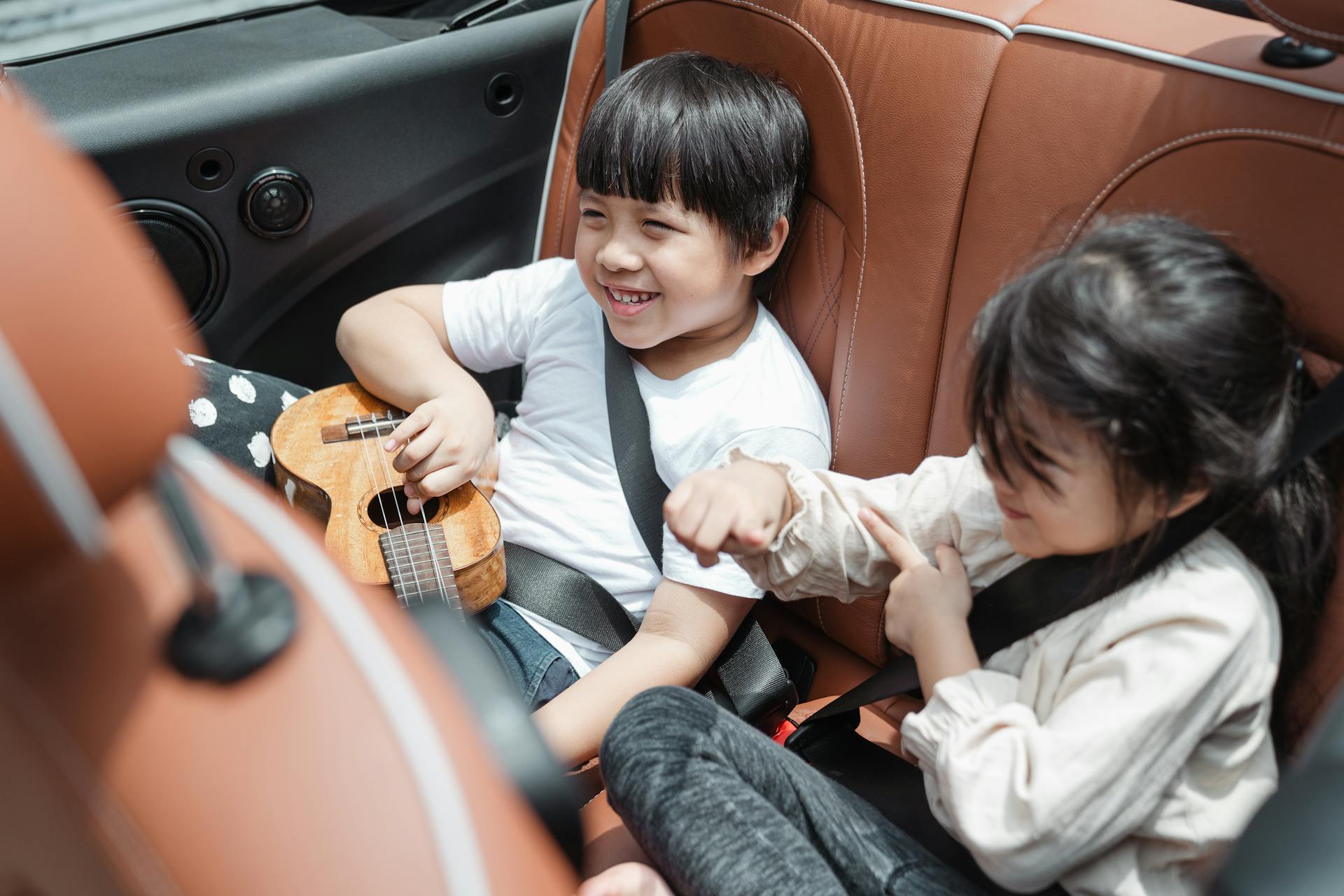
Even a well-run car hits a wall eventually. What separates the families who bounce back from the ones who spiral is having a plan for the bad twenty minutes, not just the good six hours.
- Name the long day at breakfast (the r/roadtrip trick), so a hard stretch never arrives as a surprise.
- Call the next stop out loud ("bathroom and running around in 40 minutes") so there is always a finish line in view.
- Rotate seats at stops so nobody is stuck for six hours next to the sibling they are feuding with.
- Spend a screen block on cooperation, not as a bribe but as the planned hour-five release you already budgeted.
- When it really spirals, pull over. Five minutes of fresh air resets a back seat faster than any threat from the front.
This guide stays on the execution side: timing, entertainment, snacks, and the back seat. For where to actually go and how to route it, see the family road trip planning guide. To dodge the classic errors that sink a trip before the driving even starts, read common family vacation mistakes to avoid.
The Bottom Line
A family road trip goes well when you pick the right drive-day plan before leaving: nap-time driving for under-5s, an early-start daytime run for ages 6 to 12, a two-driver overnight for long hauls, or a two-day split with a hotel whenever the route tops 8 hours. Cap the daily miles by your youngest kid's age, stop every 2 to 3 hours, and ration entertainment on the escalation ladder so the games, snacks, and screens last the whole way. Do that, and the back seat mostly runs itself. Run the numbers on your own route with the budget calculator, then map the stops with the itinerary builder.
Frequently Asked Questions
The 3-3-3 rule for road trips means driving no more than 300 miles a day, stopping every 3 hours, and staying at least 3 nights before moving on. It is a useful starting rhythm, but with kids the smarter cap is by age: toddlers max out near 4 to 5 hours a day while school-age kids manage 7 to 9.
Most kids handle 4 to 9 hours of car travel a day, depending on age and breaks. Toddlers realistically max out around 4 to 5 hours, young kids 4 to 7 manage 5 to 7 hours, school-age kids 8 to 12 do 7 to 9, and teens can go longer with music and naps. Stop every 2 to 3 hours to keep everyone from hitting a wall.
Cap daily driving by your youngest passenger's age rather than by a fixed mileage. Toddlers do best with 4 to 5 hours, school-age kids with 7 to 9, and teens can push past 10 with their own playlist. If the total route tops 8 hours, split it into two days with a hotel stop and arrive fresh.
Ration entertainment instead of handing it all out at once. Keep the first hour low-key with window-watching and a family playlist, then escalate: a coloring pad, then an audiobook, then games like I Spy and the License Plate Game, then screens for the final stretch. Give each kid their own bag, since siblings rarely get bored at the same minute.
Screen time is a valid road trip tool when you save it rather than default to it from mile one. Held back until hour four or five, screens feel like a treat and work harder because kids are not already sick of them. Download shows before leaving since service gets spotty, pack kid-sized headphones, and bring a battery pack.
The best road trip snacks are non-messy and protein-forward, so they curb hunger without turning the back seat into a cleanup job. Good picks include cheese sticks and crackers, dried fruit, granola bars, applesauce pouches, pretzels, popcorn, and bananas. Skip chocolate, which melts the moment the sun hits the window, plus sugary candy and open cups of juice.
The toddler years, roughly ages 1 to 3, are the hardest stage to road trip with, because a toddler's daily tolerance for driving is lowest. They max out near 4 to 5 hours and cannot follow most games or audiobooks yet. The upside is that they sleep well in a moving car, so nap-time and overnight driving turn the hardest age into the quietest miles.
Drive overnight when the route tops 10 hours and you have two drivers to swap, because kids sleep through the miles and skip the entertainment problem entirely. Drive during the day, anchored to the 1 to 3 PM nap slot, for anything shorter or when a single driver would be too tired at 3 AM. Driver alertness is the deciding factor.
Data Sources and Methodology
This guide draws on child-safety guidance, motion-sickness prevention advice, and parent discussions across travel forums. The drive-day formats and age caps are editorial judgment built from those sources and cross-checked against common parent experience.
Key Sources
- HealthyChildren.org (AAP), car-seat time limits and break recommendations for infants
- Mayo Clinic Health System, motion-sickness prevention strategies for children
- Safe in the Seat, car-safety essentials and back-seat organization for families
- Parent discussions from r/roadtrip, r/FamilyTravel, and r/Parenting
Last verified: July 2026. Entertainment, snack, and pacing recommendations reflect commonly cited parent experiences across travel communities; the drive-day decision framework is Endless Travel Plans editorial guidance.