Thailand vs Vietnam for Families: $4,120 Before Airfare
Ten days on the ground for two adults and two kids, priced line by line in both countries.
Quick Answer: Thailand vs Vietnam for Families
- Vietnam is cheaper for a family of four: about $2,531 over ten days on the ground against the other country's $3,270 (as of August 2026, sources: Bangkok Airways and Vietnam Airlines fares plus the July 2026 ETP lodging basket).
- One line in the cost table runs the other way, and it's a boat rather than a hotel. At the top of the tier it hands back most of what the cheaper country saves on rooms.
- Nine mid-range family-room nights run $405 to $900 in Vietnam against $1,080 to $1,530 in the other country, the biggest line in both columns (as of July 2026, source: the ETP country cost guides for both). Vietnam suits kids 8 and up; under 6 is easier in the other one.
- The US State Department rates both countries at the same tier, and the only province-level carve-out in either advisory belongs to the one with the famous islands.
- Skip this if you've picked the country and only need the island: our Costa Rica vs Belize comparison runs the same test for the Americas, and our Caribbean all-inclusive breakdown covers the one-resort version.
- Below: the row where the cheaper country charges more and how much of its room saving it hands back, under "Is Vietnam Cheaper"; and what each advisory says, under "Which Is Safer". Price your own dates in the family budget calculator.
Families open two tabs and compare bowls of pho against plates of pad thai, and the meal line is nearly the smallest thing on the page. Nine hotel nights separate these trips: $675 apart at the cheap end of the mid-range tier, before anyone has eaten (as of July 2026, source: the ETP country cost guides for both). Start at "Is Vietnam Cheaper" for the row that runs the other way, then price your dates in the budget calculator.
How Thailand and Vietnam Compare for Families
Every money row prices one basket: ten days on the ground, nine hotel nights, two adults and two children, mid-range tier, airfare excluded. The cost rows come from the itemized table below, so you can check the math.
| Category | Thailand | Vietnam | Winner |
|---|---|---|---|
| 10-day ground cost, family of 4 | $2,420 to $4,120 | $1,482 to $3,580 | Vietnam |
| Daily ground cost, family of 4 (total divided by 10, flights and excursion included) | $242 to $412 | $148 to $358 | Vietnam |
| Mid-range family room, per night | $120 to $170 | $45 to $100 | Vietnam |
| Signature excursion, 4 people | $200 to $480 | $360 to $900 | Thailand |
| Days needed for the highlights | 7 to 10 days | 12 to 14 days | Thailand |
| US State Department advisory | Level 1, three provinces carved out | Level 1, no carve-out | Tie (Level 1 both) |
Sources: the carriers' own route pages and the US State Department country advisories (as of August 2026); room, food and excursion bands are the ETP basket priced in July 2026 and carried forward.
Choose Thailand If This Sounds Like Your Family
Thailand is the smoother ride when little kids and short travel days beat saving money. Pick it if:
- Your kids are under 6 and you want calm, shallow beaches and stroller-friendly resorts.
- It's your first trip to Southeast Asia and you want English signage.
- You want a resort holiday with kids' clubs and few decisions.
- You've 7 to 10 days and want beaches and a city, no long transfers.
Choose Vietnam If This Sounds Like Your Family
Vietnam rewards families who trade convenience for cost and better stories. Pick it if:
- Your budget is tight; at the bottom of the tier four people save $938 over ten days.
- Your kids are 8 or older and like kayaking and hands-on history.
- Food matters to you; pho and banh mi are cheap and everywhere.
- You want a trip your teens still talk about at Thanksgiving.
When It Depends: The Three-Question Decision Test
Most families land in the middle. To break the tie:
- How old are the kids? Under 6 leans Thailand, 8 and up leans Vietnam.
- What's the daily ground budget for four? Under $200 points to Vietnam; $300 or more opens Thailand's resorts.
- Beaches or culture? Beaches means Thailand; culture and food means Vietnam.
Two answers the same way is your country; if they split, budget breaks the tie. Wider options? Our Costa Rica vs Belize comparison uses the same test for the Americas, and our best European cities ranking covers the short-haul version if flight time is the real problem.
Is Vietnam Cheaper Than Thailand? (The Gap Shrinks as the Trip Gets Nicer)
Yes, and by less than the internet says once the trip stops being a backpacking route. The same ten days, line by line; add the column and you get the total.
| Line item | Thailand | Vietnam |
|---|---|---|
| 10-day total on the ground | $2,420 to $4,120 (midpoint $3,270) | $1,482 to $3,580 (midpoint $2,531) |
| Family room, 9 nights ($120-$170 vs $45-$100 a night) | $1,080 to $1,530 | $405 to $900 |
| Food, 10 days, all four ($40-$70 vs $28-$68 a day) | $400 to $700 | $280 to $680 |
| Two internal flights, 4 people (both directions) | $290 to $610 | $207 to $530 |
| Local transport, 10 days ($15-$30 vs $11-$23 a day) | $150 to $300 | $110 to $230 |
| Everyday activities and entry ($30-$50 vs $12-$34 a day) | $300 to $500 | $120 to $340 |
| Signature excursion, 4 people (Phi Phi day trip vs Ha Long overnight) | $200 to $480 | $360 to $900 |
Flights priced from Bangkok Airways' own starting fares (Krabi from 1,200 baht, Koh Samui from 2,500 baht one way) and Vietnam Airlines' own route pages (Hanoi to Da Nang from 680,000 dong, Ho Chi Minh City to Da Nang from 666,181 dong, and a stated typical one-way start of USD 66.2 to Ho Chi Minh City), converted at 32.96 baht to the dollar, the European Central Bank reference rate for August 28, 2026, and at 26,042 dong to the dollar, the carrier's own conversion (USD 66.2 to VND 1,724,000) (as of August 2026). Every other band is the ETP basket priced in July 2026 and carried forward, because nobody publishes a rate card for a family week (as of July 2026, source: Endless Travel Plans).
Now the part a headline percentage hides. At the bottom of the mid-range tier Vietnam comes in $938 below Thailand, or 39 percent of the Thai total. At the top the gap is $540, or 13 percent. Same basket, and the advantage more than halves as the rooms get nicer.
One row explains almost all of it. Nine hotel nights are $630 cheaper in Vietnam at the top of the tier, the biggest single saving in the table. The excursion runs the other way: an overnight Ha Long Bay cruise for two adults and two half-price kids tops out at $900 against $480 for a Phi Phi speedboat day out of Phuket, so that line gives back two thirds of the room saving. It is the only row where the cheaper country charges more, and nobody trims it, because the boat's why you went.
We'll be blunt. Book three-star rooms and eat where the plastic stools are, and Vietnam is materially cheaper. Book the nicer room and the cruise, and you're picking Vietnam for the trip, not the price.
Two other pages here price this trip on slightly different baskets. Our Vietnam family cost guide puts a mid-range ten days at $2,500 to $4,000 on the ground, but its column also carries e-visas, insurance and bottled water, which this table excludes; strip those and the two Vietnam columns land within about $170 of each other. It also prices a budget tier this table doesn't, and there it has Vietnam coming out dearer than Thailand, so don't assume the gap holds all the way down. Our Thailand family guide puts a mid-range ten to fifteen days at $3,500 to $5,000 before flights, wider at the top because it prices up to five more days. Our Thai islands ranking prices seven resort days at $3,500 to $5,500 on lodging of $150 to $450 a night, against the $120 to $170 mid-range family room used here, and our two-week itinerary prices a three-region route with two domestic flights, a different trip from the two-region plan costed here (as of July 2026 and August 2026, source: Endless Travel Plans).
Beaches and Kid-Friendly Activities
Thailand's Beach Advantage
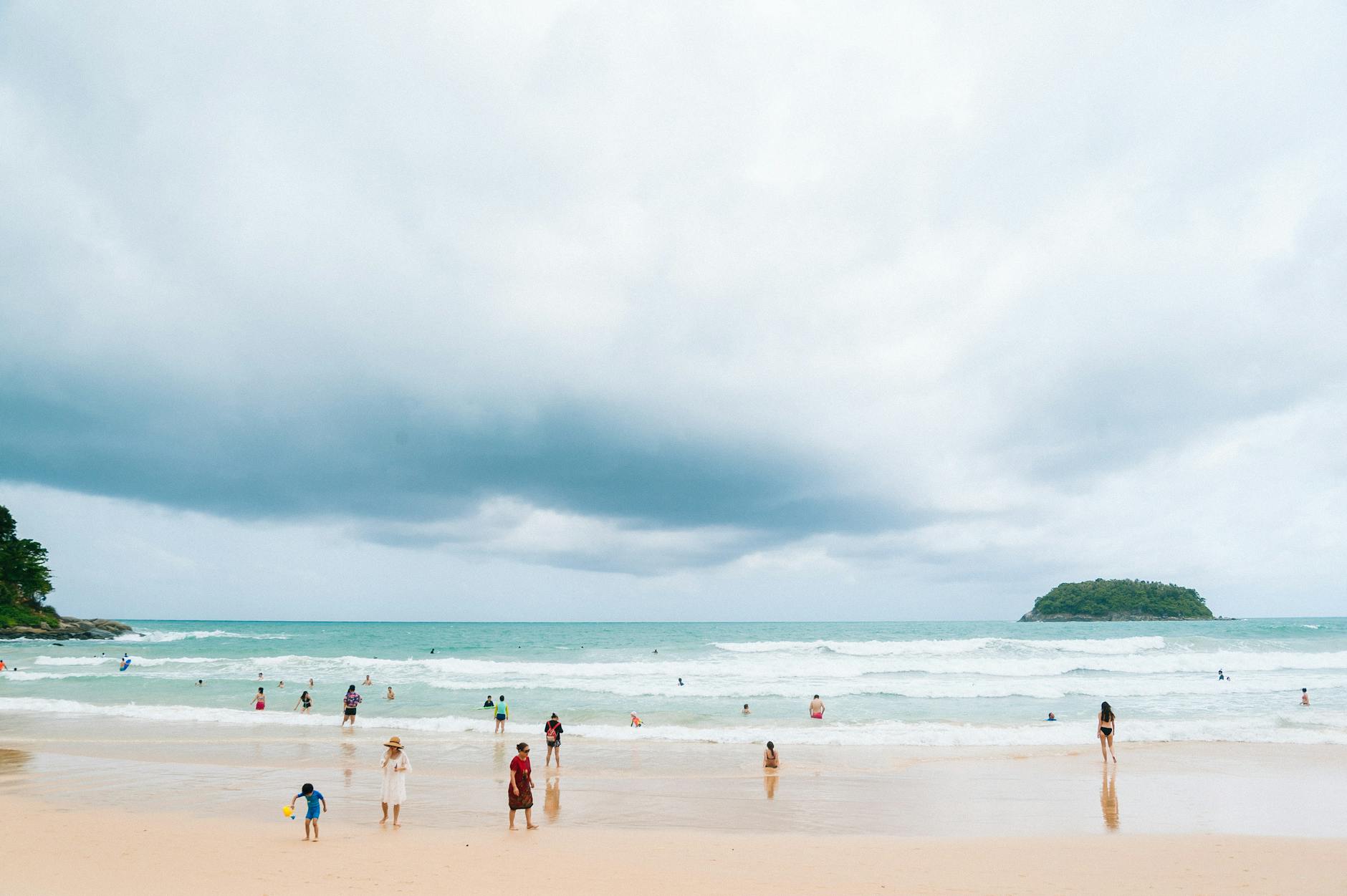
Kata Beach in Phuket slopes gently into shallow water, has lifeguards and puts restaurants right behind the sand. Klong Dao on Koh Lanta is calmer still (honestly one of the most kid-friendly stretches in Southeast Asia). Two coasts help as much as the sand does: when the Andaman side is in its monsoon, the Gulf islands are dry, so there's almost always a beach in season. Off the sand there are ethical elephant sanctuaries near Chiang Mai, snorkeling off Koh Tao and Bangkok's Safari World for younger kids.
Vietnam's Cultural Edge
Vietnam doesn't win on beaches. It wins on the experiences kids are still describing a year later: kayaking through limestone caves in Ha Long Bay, lantern-making workshops in Hoi An that even 5-year-olds can join, and the Cu Chi Tunnels turning history into something kids crawl through.
So what about Vietnam's beaches? My Khe in Da Nang is wide, clean and good for stronger swimmers, and Phu Quoc has been building family resorts hard. But they sit further apart, and the central coast catches typhoons from September to November.
Feeding Picky Eaters in Southeast Asia
Both countries are easier for selective kids than parents expect; the trick's knowing what to order. In Thailand, go with pad thai, chicken satay and khao man gai, which is chicken and rice and nothing else. Most kitchens tone down the spice if you ask.
Vietnam's pho is dependable kid food: warm broth, rice noodles, whatever protein they'll accept. Across ten days the food line separates the two trips by $120 at the bottom of the tier and $20 at the top, which is why noodle prices are the least useful thing to argue about on a planning evening.
Which Is Safer, Thailand or Vietnam?
Officially, neither. The US State Department places both at Level 1, exercise normal precautions, its lowest of four tiers (Thailand's issued July 2026, Vietnam's June 2026, source: the US State Department country advisories). Same tier as Japan.
The difference is in the exceptions. Vietnam's advisory names no province-level carve-out; it flags petty crime, plus landmines and unexploded ordnance in rural areas. Thailand's asks for increased caution in three southernmost provinces, Yala, Pattani and Narathiwat, for the risk of unrest, and near the Thai-Cambodian border for the risk of armed conflict (as of August 2026, source: the US State Department Thailand travel advisory). None of those is near Phuket, Krabi, Koh Samui, Bangkok or Chiang Mai. The country with the formal carve-out is the one families call the easy option, and the carve-out sits nowhere near their itinerary.
Vietnam does hold a real number here, and it's usually quoted wrong. Its 92 out of 100 on Gallup's Law and Order Index is a five-way tie with Finland, Iceland, Kuwait, Luxembourg and Norway, and Tajikistan sits above them at 96, on 2022 data (source: Gallup). Excellent, not first place, not a 2026 figure.
The daily risk in both countries is traffic, and Vietnam's is harder. Crossing a street in Hanoi with a toddler takes nerve, and sidewalks are often blocked by parked motorbikes, so a baby carrier beats a stroller. Grab works in both; use GrabCar, not the motorbike option, with small kids.
One rule changed recently and most guides still have it wrong. Vietnam's Decree 238/2026/ND-CP brought penalties into force on August 15, 2026 for carrying a child under 10 and shorter than 1.35 meters without a suitable restraint, and keeps those children out of the front passenger seat. What matters at the curb: commercial passenger vehicles are exempt, which is what a Grab car or a metered taxi is (as of August 2026, source: Viet Nam News Agency). The law won't put a car seat in your taxi. Bring your own.
When to Visit Thailand or Vietnam With Kids
Timing matters more than families expect. Get it wrong and you'll watch rain from a lobby.
November through February is the sweet spot for both. Thailand's Andaman coast and Vietnam's center and south share that window; Thailand's Gulf islands shift to January through April, which is the quirk that saves a summer trip.
Locked into June-to-August school holidays? Thailand's Gulf coast still works; Vietnam's north gets heavy rain then. The Thai Meteorological Department's bulletin of August 30, 2026 put the monsoon trough across northern Thailand and into an active low over the coast of upper Vietnam and the Gulf of Tonkin, the pattern that soaks Ha Long Bay in late summer (as of August 2026, source: the Thai Meteorological Department). If summer is your only window, a European city trip is often the easier call.
What Families Actually Say on Reddit and Forums
The same debate runs everywhere. A long r/chubbytravel thread about two young children lands on the view that Thailand's more kid-friendly day to day, and Google surfaces it first. The pushback comes from parents of older kids: on r/VietNam, many say Vietnam's food, lower costs and hands-on history win once children are 8 or older. Both camps agree that cramming both countries into ten days leaves families exhausted and over budget. None of the cost figures here come from forums.
Quick Decision Framework by Family Type
The call by situation:
- Kids under 5: Thailand. Shorter legs, calmer beaches, kids' clubs.
- Ground budget under $2,000: Vietnam, on the day trip not the overnight cruise.
- Ground budget over $3,500: pick on the trip, not the price. The countries are $540 apart there.
- Return visitors: Vietnam. After Thailand it feels new.
Our take
Vietnam is the cheaper country for a family of four at both ends of the mid-range tier, but the size of the win depends on how you travel: $938 over ten days at the bottom of the mid-range tier, $540 at the top. Anyone quoting one percentage has picked a tier without telling you.
So here's the call. With kids under 6, book Thailand: two coasts means a dry beach almost year round, the hops are shorter, and the room you pay extra for has the shallow pool. With kids 8 and up, book Vietnam: what you save on nine hotel nights is roughly what pays for the night on the water. In between the tiebreaker is the route. Thailand fits its highlights into 7 to 10 days; Vietnam wants 12 to 14, and families who force ten lose two to airports.
Price both on your dates in the budget calculator, then map the pace in the itinerary builder before you book.
Frequently Asked Questions
Thailand is the better choice for families with kids under 6, thanks to calm, shallow beaches, stroller-friendly resorts and shorter internal legs, while Vietnam suits kids 8 and older who enjoy Ha Long Bay kayaking and the Cu Chi Tunnels. For ages 7 to 14 either country works, so budget and the beach-versus-culture question usually decide it. On the ground, ten days for a family of four runs $2,420 to $4,120 in Thailand against $1,482 to $3,580 in Vietnam, international airfare excluded.
A 10-day family trip in 2026 costs $2,420 to $4,120 in Thailand and $1,482 to $3,580 in Vietnam for a family of four on the ground, international airfare excluded. Day to day that works out to about $242 to $412 in Thailand against $148 to $358 in Vietnam. That daily figure is the ten-day total divided by ten, so it spreads the two internal flights and the signature excursion across every day and averages nine room nights over ten; our Thailand family guide's $205 to $310 mid-range daily total covers rooms, food, local transport and everyday activities only (as of July 2026, source: Endless Travel Plans). The gap is widest at the bottom of the mid-range tier, where Vietnam runs 39 percent below Thailand, and narrowest at the top, where it runs 13 percent below.
Yes, $50,000 is far more than enough for a family trip to Thailand, where ten days on the ground for a family of four costs $2,420 to $4,120 in 2026, international airfare excluded. Round-trip flights from the US add roughly $800 to $1,400 per person on top of that (as of July 2026, source: Endless Travel Plans). Even at the high end the whole trip lands near $9,700 for four people, so $50,000 would cover it five times over.
The US State Department rates both Thailand and Vietnam at Level 1, exercise normal precautions, which is its lowest advisory tier (Thailand issued July 7, 2026; Vietnam issued June 24, 2026). Thailand's advisory carves out three southern provinces, Yala, Pattani and Narathiwat, for the risk of unrest, and asks for increased caution near the Thai-Cambodian border because of the risk of armed conflict. Vietnam's advisory names no province-level exception and flags petty crime in tourist areas plus landmines and unexploded ordnance.
At 6pm in Thailand the national anthem plays over public loudspeakers, television and radio, and people pause and stand still until it finishes, usually under a minute. It also plays at 8am. For families it is a harmless, kid-friendly cultural moment, so stop walking and stand quietly along with everyone else.
Vietnam is the better pick for families with kids 8 and older or teens, who get more out of Ha Long Bay kayaking, Hoi An lantern workshops and crawling through the Cu Chi Tunnels, and it costs less on the ground at both ends of the mid-range tier. Thailand still edges ahead for toddlers and kids under 6 who need calmer beaches and easier logistics. The ground-cost gap runs from 39 percent at the bottom of the mid-range tier down to 13 percent at the top.
Both Thailand and Vietnam sit at Level 1 on the US State Department's advisory scale, its lowest tier, so neither is the safer country in any official sense (Thailand issued July 7, 2026; Vietnam issued June 24, 2026). Vietnam scored 92 out of 100 in Gallup's Law and Order Index, tied with Finland, Iceland, Kuwait, Luxembourg and Norway and behind Tajikistan's 96, on 2022 survey data. For families the daily risk in both countries is traffic, not crime.
Thailand is not on any US government do-not-travel list. The State Department's advisory of July 7, 2026 keeps the country at Level 1, exercise normal precautions, and asks for increased caution only in Yala, Pattani and Narathiwat provinces and near the Thai-Cambodian border. Popular family areas including Phuket, Bangkok, Chiang Mai and Koh Samui fall under neither carve-out.
Prettier is a preference rather than a ranking, and the two countries win on different terrain: Thailand on tropical islands and limestone sea stacks, Vietnam on karst bays, terraced rice fields and lantern-lit old towns. For families the useful version of the question is which scenery your kids can reach without a long transfer. Thailand's best views sit within a short boat ride of a beach base, while Vietnam's are spread across more than 1,000 miles, so seeing two of them costs a travel day.
No, Thailand has the better family beaches. Kata Beach in Phuket and Klong Dao on Koh Lanta shelve gently into calm, shallow water with restaurants directly behind the sand, and having both an Andaman and a Gulf coast means one side is usually in its dry season. Vietnam's My Khe in Da Nang and the resort strips on Phu Quoc are wide, clean and good for stronger swimmers, but they sit further apart and the central coast catches typhoons between September and November.
The most expensive mistake is treating Vietnam as one destination and trying to cover Hanoi, Hoi An and Ho Chi Minh City in ten days, which spends two of them in airports for a country running more than 1,000 miles top to bottom. The most common practical mistake is assuming a taxi will carry a car seat. Vietnam's Decree 238/2026/ND-CP brought penalties into force on August 15, 2026 for carrying a child under 10 and shorter than 1.35 meters without a suitable restraint, and it keeps those children out of the front passenger seat, but commercial passenger vehicles, which is what a Grab car or a metered taxi is, are exempt.
Data Sources and Verification
This page runs on two clocks. Internal flight fares, both travel advisories, the Gallup score, the Vietnamese child-restraint decree and the currency conversion were read on each publisher's own site in August 2026. The room, food, local transport, activity and excursion bands are the ETP family basket priced in July 2026 and carried forward unchanged, because no airline, hotel group or tour operator publishes a rate card for a whole family week. Nothing has been restamped to look fresher than it is.
- Tourism Authority of Thailand (TAT): destination and regional guidance
- Viet Nam National Authority of Tourism: destination and regional guidance
- Bangkok Airways route pages: published one-way starting fares from Bangkok to Krabi, Phuket and Koh Samui
- Vietnam Airlines route pages: published one-way starting fares for Hanoi to Da Nang, Ho Chi Minh City to Da Nang and Hanoi to Ho Chi Minh City
- US State Department country travel advisories for Thailand and Vietnam: advisory levels and the province-level exceptions
- Gallup Law and Order Index: the Vietnam score and the countries it ties with, on 2022 survey data
- Viet Nam News Agency: Decree 238/2026/ND-CP and the commercial-vehicle exemption
- Thai Meteorological Department: the late-August monsoon position
- European Central Bank daily reference rates: the baht conversion used in the flight lines
- Parent experiences: r/chubbytravel, r/VietNam and family-travel forums, used for color and never for a price
Costs verified August 2026, cost basket July 2026. Family-of-four figures cover ten days on the ground with nine hotel nights and exclude international airfare, travel insurance and visa fees. Peak weeks over Christmas, New Year and Tet run higher, so check your own dates against the named sources before booking.